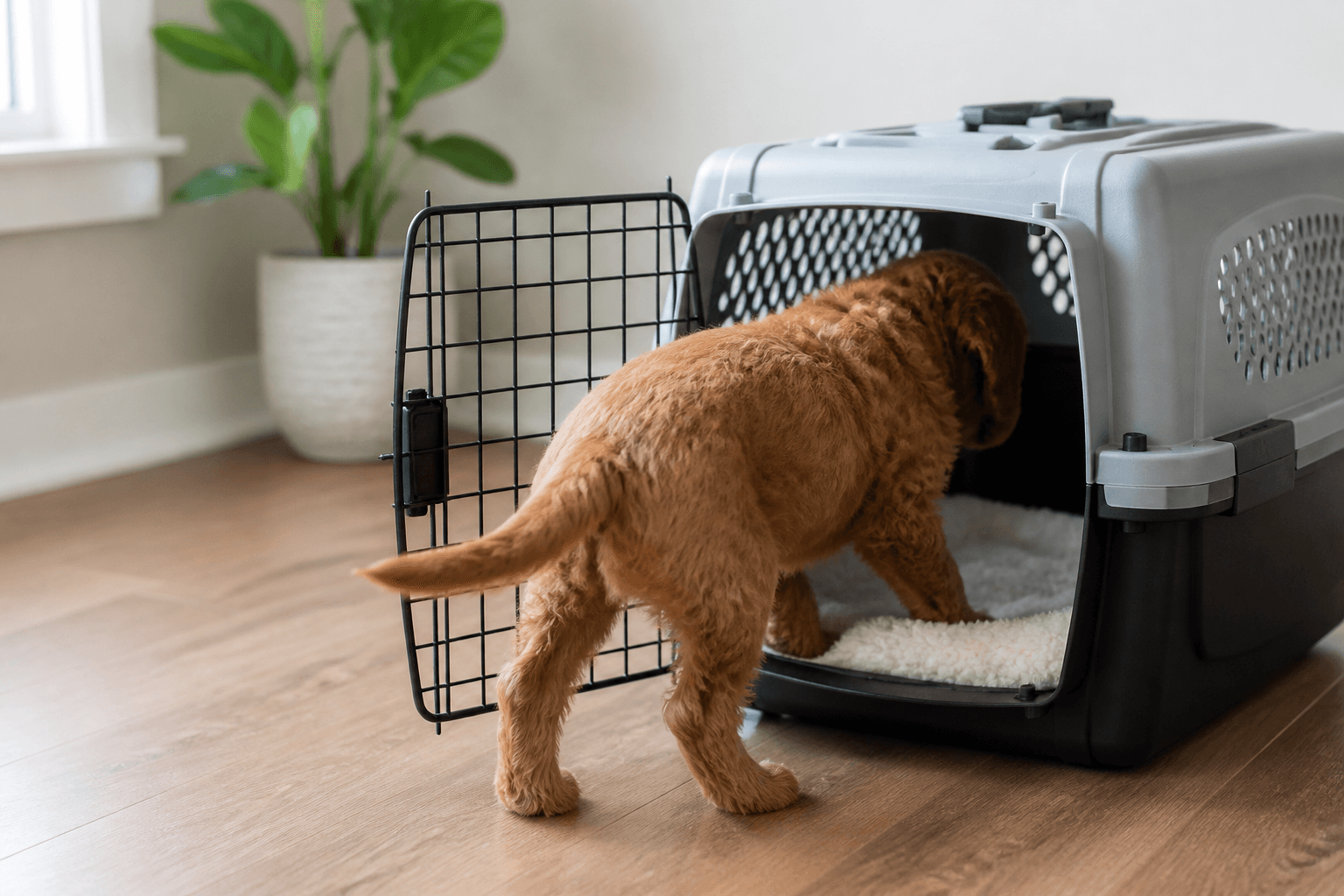
An adaptation in really small steps
Don't wait for a scheduled trip to present the box. Do short sessions at quiet times and stop while the puppy is still well. Several easy experiments often teach more than one long session.
1. The box appears without requiring input
Leave the door stuck open so it doesn't slam. Sit nearby, spread some snacks around and allow exploration. Do not push the puppy or place it inside. If he avoids you until he approaches, reward looks and steps towards the crate. The first criterion might be just being close without tension.
2. Entering and leaving remains a choice
Place a snack at the entrance and then a little further down. Use part of the meal, if appropriate, to avoid excess. The puppy comes in, eats and leaves. Don't close the door in surprise. Repeat until he approaches voluntarily and maintains a relaxed posture.
A word like “box” can be said before he enters, but don't turn the command into pressure. Voluntary movement is more important than speed. If he stretches his body without putting his hind legs on, the step is still difficult; bring the reward closer.
3. The door moves for a moment
When he enters easily, touch the door, reward and open it completely. Then move it a few centimeters. Only then close it for a second and reopen it. Deliver the treat while the door is closed, not just after you leave. Thus, closure predicts something good.
Increase from one to two, three and a few seconds in different sessions. If the puppy stops eating, scratches or tries to escape, return to the point where he was comfortable. Backing down does not “ruin” the training; prevents fear from being rehearsed.
4. The tutor changes position
With the door closed for a short period, move your body, stand up and sit down, take a step and come back. Alternate distance and duration: if you move further away, reduce the time. Do not simultaneously increase closed door, distance, noise and duration.
Return before the cub reaches despair. This is different from opening at the exact moment of a frustrated bark. In an easy workout, wait for a brief natural pause to open up. In a panic, prioritize removing the animal calmly and reschedule a much simpler step; prolonging suffering does not teach self-regulation.
5. The box moves
Close the door, lift the box correctly and support it again. Then carry it a few steps indoors. Keep it level. Some puppies agree to stay inside, but they are scared by the swinging and the noise of the handle. Training this element separately avoids a surprise on the day of the trip.